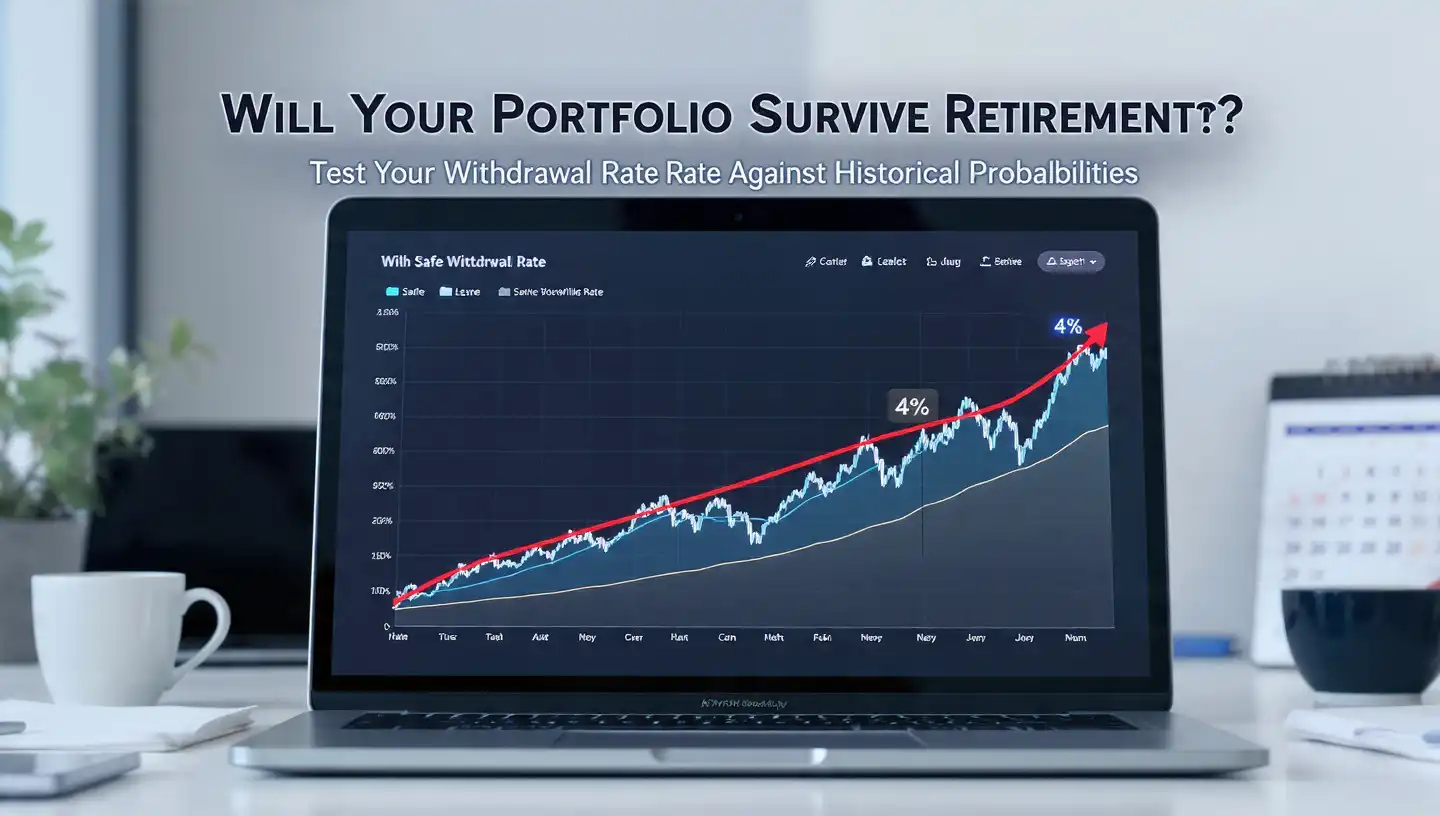
Safe Withdrawal Rate (SWR)
Will your portfolio survive retirement? Test your withdrawal rate against historical probabilities.
How This Tool Works
This calculator determines the Safe Withdrawal Rate (SWR) for your portfolio based on the findings of the Trinity Study and historical market performance.
- The 4% Rule: Historically, a portfolio of 50-75% stocks had a 95% chance of lasting 30 years if you withdrew 4% in the first year and adjusted for inflation thereafter.
- Logic: We compare your requested withdrawal rate against historical "failure" and "success" probabilities (e.g., if you withdraw 5%, the chance of running out of money increases significantly).
- Sequence Risk: The safety of a rate depends heavily on market returns during the first 5-10 years of your retirement.
How to Use (Steps)
- Portfolio Value: Your total liquid assets available for retirement.
- Annual Withdrawal: The actual dollar amount you plan to take out in Year 1.
- Retirement Duration: 30 years is standard, but "Early Retirees" should plan for 40-60 years.
- Asset Allocation: Balance between high-growth stocks and stable bonds.
Example Calculation
Scenario: $1,000,000 Portfolio with a $40,000 Withdrawal.
• Withdrawal Rate: 4.0%.
• Success Chance (30 Yrs): ~98%.
• Success Chance (50 Yrs): ~85%.
• Verdict: 4% is very safe for 30 years, but 3.5% ($35k) is recommended for FIRE-length horizons.
Why This Tool Is Accurate
Unlike simple dividend calculators, this tool accounts for Total Return and Inflation. It uses the same parameters as the original Trinity Study, updated for modern market volatility, to help you avoid the catastrophic mistake of over-withdrawing in a down market.
Limitations & Disclaimer
Past performance does not guarantee future results. Future market returns may be lower than the 20th-century average. Disclaimer: This is a simulation tool; please consult with a fiduciary financial advisor for a comprehensive plan.
Frequently Asked Questions
The 4% rule was designed for a 30-year horizon. For early retirees looking at 50+ years, many experts now suggest "Dynamic Spending" or a lower initial rate of 3.25% to 3.5% to account for extended longevity.
Yes. The "Rule" assumes you take $(Initial Amount) + Inflation$ every year. This ensures your standard of living remains constant even as prices rise over decades.
This is called "Sequence of Returns Risk." If the market drops 30% right after you retire, you may need to reduce your spending temporarily (Variable Percentage Withdrawal) to ensure your portfolio can recover.